
Small nail holes in sound drywall usually need a surface repair rather than a replacement panel. The surrounding paper should be firm and dry. Deep damage, repeated cracking and dampness require a different approach.
In this guide
Tools and preparation
- A small putty knife.
- Compatible spackle.
- Suitable cleanup materials.
- Primer.
- Matching paint.
Use protection specified by the product and dust assessment.
Time is a planning estimate, not a timed field test. Material prices vary; check the correct parts and local prices before buying.
Steps and safe checks
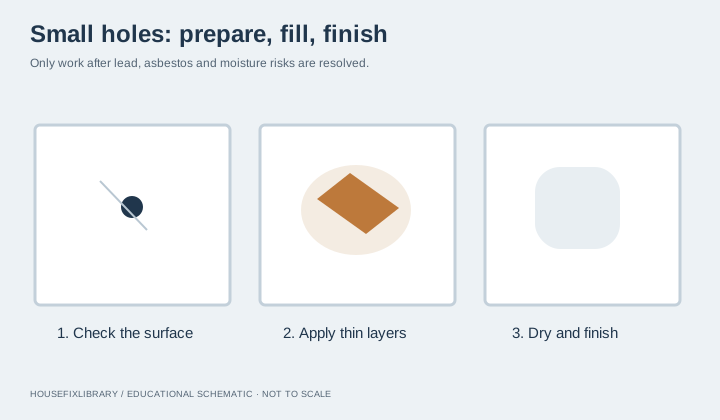
1. Prepare a sound surface
Remove the picture fixing without enlarging the damage. Once hazardous-material risks are resolved, clear loose debris and gently flatten raised paper as appropriate for the repair product. Protect the floor and nearby furnishings.
2. Apply a small amount
Press spackle into the hole with the knife and draw the blade across the surface. Use the product’s permitted layer thickness; a large mound is harder to finish and may dry unevenly.
3. Allow complete drying
Follow the label for drying and recoating. Temperature, depth and humidity affect readiness. If the patch shrinks, add a further thin application after the first has dried rather than painting over a depression.
4. Finish and coat
If required, smooth the dry repair with the method specified on the product and control dust. Remove residue. Prime where the patch or paint instructions require it, then apply matching paint.
Check the result
Inspect with light coming across the wall. The patch should be flat, firm and dry. A matching color may still differ in sheen; a larger paint area can be necessary for an even appearance.
Common mistakes
Common problems are filling a damp wall, applying too much at once and painting before the repair is ready. Spackle does not correct a loose board or an active crack.
When to call a professional
Get help with broad damage, recurring movement, a soft surface or unresolved lead or asbestos concerns. Do not cut into the wall to explore a minor hole.
What can happen if you postpone it?
A dry nail hole is usually cosmetic and can wait for convenient decorating. Dampness or recurrent cracking is a different problem and should be assessed before filling.
Prevent a repeat
Use a fixing suitable for the wall and load. Remove hooks carefully and keep the paint name, finish and batch details for future touch-ups.
Sources and scope
- DAP: Spackling 101
- EPA: Lead-Safe Renovations for DIYers
- EPA: Protect Your Family from Exposures to Asbestos
Source check: November 4, 2026. AI-assisted educational writing checked against the linked documentation; no firsthand testing or licensed professional review is claimed. Manufacturer instructions and applicable local requirements take priority.