
A useful starter kit supports the safe tasks you actually plan to do. Buying a large assortment can leave you with many accessories and no clear repair method. Begin with a guide, identify the required tools, and check whether borrowing or renting is appropriate.
In this guide
Tools and preparation
- A list of planned tasks.
- A dry.
- Secure storage place.
This is a selection guide, not a requirement to buy every item at once.
Time is a planning estimate, not a timed field test. Material prices vary; check the correct parts and local prices before buying.
Steps and safe checks
1. Start with observation and measurement
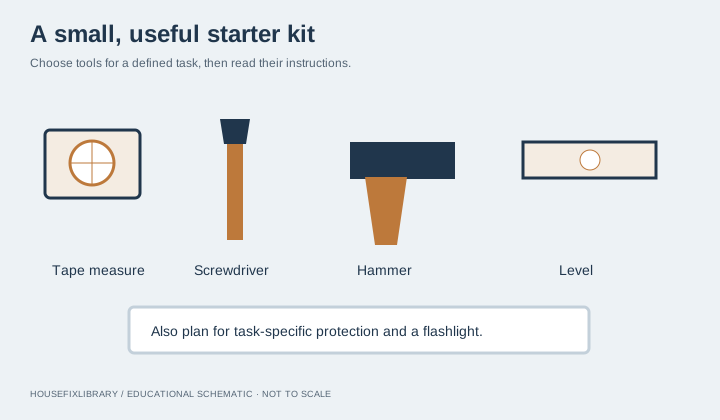
A flashlight, tape measure, pencil and notebook help with many noninvasive checks. Learn to read the tape and record dimensions before buying a powered tool.
2. Choose basic hand tools carefully
Select screwdrivers that fit the fasteners you will handle, a suitable hammer, pliers where needed and a small level. A mismatched driver can damage a screw and make a minor job harder.
3. Add task-specific items
A putty knife belongs with an appropriate surface-repair job; an aerator key belongs with the faucet that needs it. Check the repair and product instructions rather than substituting whatever happens to fit.
4. Plan protection and storage
Include the protection required for the task, then clean and inspect tools before storing them. Keep sharp edges covered and batteries or chemicals stored according to their instructions.
Check the result
A practical kit has a purpose for every item and the information needed to use it. Missing safety instructions or a poor fit is a reason to revise the plan.
Common mistakes
Avoid using pliers as a universal wrench, screwdrivers as pry bars or a powered drill for a task that needs controlled hand tightening.
When to call a professional
Get professional help when the job involves electrical systems, gas, structural work or hazardous materials, regardless of which tools you own.
What can happen if you postpone it?
Buying a large kit before choosing your jobs can waste money and storage. More tools do not supply the training needed for electrical, gas or structural work.
Prevent a repeat
Review the kit after each completed task, replace damaged tools and retain specialized keys and manuals with the relevant product information.
Choose tools by task and experience
Start small. A tool does not make hazardous work suitable for DIY. Rent specialist equipment only after you understand the method and have the necessary training.
| Kit | Useful tools | Choose and use safely |
|---|---|---|
| 1. Apartment / condo basics | Tape measure, multi-bit screwdriver, hammer, pliers, flashlight, utility knife, small level, eye protection and suitable gloves. | Choose comfortable handles and correctly sized bits. Cut away from your body; retract the blade. Check landlord or condo permission before altering fixtures. |
| 2. Routine homeowner jobs | Level 1 plus a drill/driver, matched bits, socket set, adjustable wrench, caulk gun, stud finder and a stable, correctly rated step ladder. | Match sockets to fasteners. Use a low drill clutch setting for suitable screws. A stud finder cannot prove an area is free of pipes or wiring. Follow ladder labels and keep away from power lines. |
| 3. Specific repair projects | Drywall knives and saw, clamps, dust extraction and, only for a permitted compatible plumbing job, the specified PEX cutter and connection tools. | Resolve hidden services and hazardous coatings first. Check pipe, fitting, tool and local plumbing requirements as one system. Do not buy a mixed kit assuming all components fit. |
| Electrical test equipment | A correctly rated digital multimeter or dedicated voltage tester, with sound leads and the required training. | Optional specialist equipment, not a beginner permission slip for mains work. Never put a meter in current mode across a supply. A non-contact tester alone is not proof that wiring is safe to touch. |
Materials worth checking before checkout
- Sealant: substrate compatibility, joint limits, paintability and full cure time.
- Wall repair: board thickness, patch size limit, compound/tape compatibility and specified sanding grade.
- Filters: actual dimensions, airflow direction and system-approved resistance.
- PPE: use the product label and task hazards to select eye, hand, hearing and respiratory protection.
Sources and scope
- DEWALT DCD803 Drill/Driver Instruction Manual
- TOGGLER: Anchor Selection and Load FAQ
- DAP: Spackling 101
Source check: November 4, 2026. AI-assisted educational writing checked against the linked documentation; no firsthand testing or licensed professional review is claimed. Manufacturer instructions and applicable local requirements take priority.