
Build a service plan from the heater’s model and history. A tank flush and tankless descaling are different jobs, and neither should start with guessed control settings.
Tools and materials
- Heater model and serial number
- Manufacturer maintenance manual
- Last service date and water-quality information
- Plumber contact and notes about observed symptoms
Time is a planning estimate. It excludes professional repairs, drying and replacement parts unless specified.
Step-by-step checks
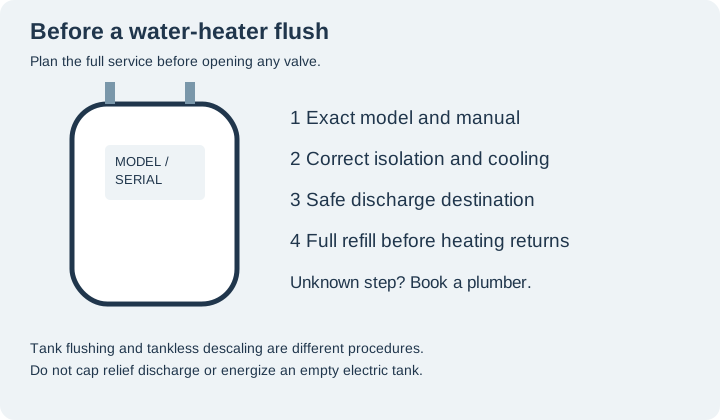
1. Match the exact heater
Record whether the heater is electric, gas, heat-pump or tankless. Photograph the accessible model label without removing covers. Obtain the corresponding manual, including any maintenance supplements.
2. Check the schedule and history
Compare the maker’s interval with water hardness and previous work. Note unusual noise, slow recovery or sediment observations, but do not diagnose a tank failure from sound alone. An unknown service history is useful information for the plumber.
3. Confirm the complete service method
Before any DIY flush, identify safe isolation, cooling, an appropriate discharge destination and the full refilling procedure from the manual. If any step is uncertain, book service. Do not assume a bucket is sufficient for a tank volume or hot discharge.
4. Agree on checks after service
Ask the provider to check for leaks and restore operation according to the manual. For an electric tank, heating must not return before the tank is full and air has cleared. Keep the service record and next review date.
Check the result
Observe accessible connections afterwards without touching hot parts. If a leak appears, stop using the equipment as directed and contact the service provider.
What can happen if you postpone it?
Sediment can impair performance, but flushing cannot repair a leaking or corroded tank. Budget for assessment rather than assuming every noise needs replacement.
When to call a professional
Use a plumber for a seized or leaking drain, corrosion, uncertain controls, unsuitable drainage or suspected tank failure. Never cap a relief discharge.
Keep a useful record
Write down the model, date, observations and next action. Save a photograph only from a safe position. Keep service invoices with your household records so the next check has a clear comparison.
Add this to your maintenance plan · Read related questions
Sources and scope
Sources checked November 5, 2026. AI-assisted educational writing; no field test or licensed professional review is claimed. Model instructions and local requirements take priority.