
A clear gutter is only part of the drainage system. Water leaving a downspout still needs an appropriate route. An extension can help in some settings, but there is no one distance or connection suitable for every property.
In this guide
Tools and preparation
- Camera.
- Notes.
- Safe ground-level access during dry weather and.
- If safe.
- Ordinary rain.
Time is a planning estimate, not a timed field test. Material prices vary; check the correct parts and local prices before buying.
Steps and safe checks
1. Trace the visible route
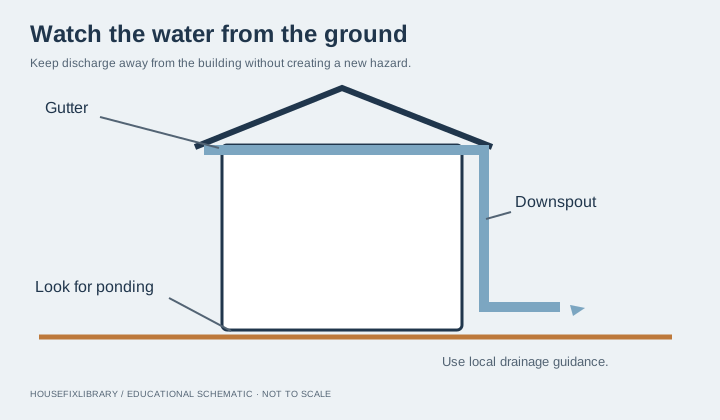
Locate the downspout outlet and note whether it empties onto the ground, a splash block or a connected drain. Do not assume a buried pipe is clear or properly connected because the top looks tidy.
2. Look for ponding and erosion
Observe low areas, washed-out soil, damp basement symptoms or water against the foundation. Record the conditions when they occur. Floodwater or sewage requires a different response from normal roof runoff.
3. Check practical hazards
Notice whether an outlet crosses a walkway, creates ice risk or discharges near steps. Avoid adding a loose extension that becomes a trip hazard or blocks needed access.
4. Choose a site-specific correction
Consult local drainage requirements and a qualified contractor where the route is uncertain. A blockage, grading issue or unsuitable buried connection may require more than moving the end of the downspout.
Check the result
The intended route should carry ordinary runoff without ponding against the home or creating a new hazard. Reassess after significant weather and any landscaping change.
Common mistakes
Avoid connecting to an unknown sewer, directing water downhill toward another property or relying on a generic extension length as proof of adequate drainage.
When to call a professional
Get professional advice for recurring basement water, erosion, buried drainage, significant grading changes or discharge restrictions.
What can happen if you postpone it?
Water discharged beside the building can keep nearby soil wet. More extension length alone will not fix an unsuitable slope or blocked downstream drain.
Prevent a repeat
Keep accessible outlets clear and check them after landscaping, leaf fall or freezing conditions. Maintain a record of where each downspout discharges.
Sources and scope
- FEMA National Flood Insurance Program: Minimize Flood Damage
- EPA: A Brief Guide to Mold, Moisture and Your Home
Source check: November 4, 2026. AI-assisted educational writing checked against the linked documentation; no firsthand testing or licensed professional review is claimed. Manufacturer instructions and applicable local requirements take priority.